

Italy Beat Belgium on Penalties to Win U17 Euro Final
Italy Win U17 Euro Title After Penalty Shootout Win
 Marco Ferraro
Updated on 08 June 2026
Marco Ferraro
Updated on 08 June 2026


Italian football has a persistent and somewhat painful habit of celebrating at youth level while grieving at senior level – and Sunday’s result in Tallinn does nothing to disrupt that pattern, even as it deserves to be acknowledged on its own remarkable terms.
This generation of Azzurrini is doing something genuinely exceptional, and the federation that struggles to convert junior gold into senior silverware should look closely at what is being built here.
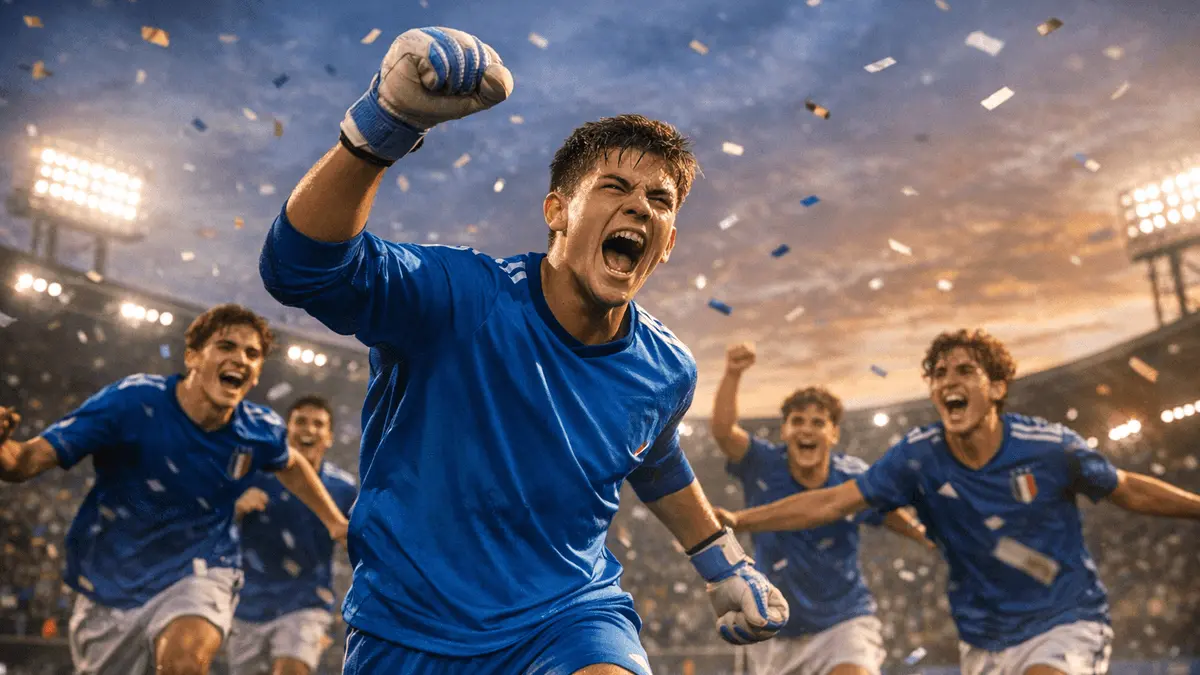
Italy’s U17 side defeated Belgium 5-4 on penalties in the European Championship final at Lilleküla Stadium in Tallinn, Estonia, after the match had ended 1-1 following extra time.
It is Italy’s second U17 European title in three years – their 2024 triumph over Portugal represented the first in the country’s history – and it confirms this particular age group as the most productive in calcio‘s embattled youth infrastructure.
Italy finished the tournament unbeaten.
The Final: How Italy Won It
The match unfolded as a tense, physically contested affair in which neither side could find a decisive margin for long stretches.
Belgium’s Mattis Seghers was the busier goalkeeper in the first half, denying Lorenzo Dattilo with a diving stop before producing another fine save to frustrate Federico Croci.
Christian Lupo, at the other end, was equally composed – alert to the early threat from Jayden Onia Seke, leaving Ilyas Benktib with nothing on the rebound.
Belgium grew into the game after the interval, and when substitute Noa Ojea Cobiella dribbled clear down the right flank in the 85th minute and sidefooted a finish to the far post, it seemed as though Italy’s dream was over.
It was not. A handball by Dierckx inside the area – the kind of moment that arrives like a pardon – gave Italy a lifeline, and Marcello Fugazzola, introduced moments before at the 87th minute, converted the penalty with ruthless composure despite Seghers diving the right way. One-all. Extra time.
Jacopo Landi, lively down the left flank, sent two efforts over the crossbar in the 77th and 82nd minutes that might have settled the tie before Belgium’s goal arrived.
In the shootout, Fugazzola opened for Italy. Lupo saved Ojea Cobiella’s attempt. Edoardo Dario Rocca dragged his kick wide.
Tinus Moorthamer struck the crossbar with Belgium’s fifth attempt – a sound that will haunt him.
Diego Perillo, who had opened Italy’s scoring in the competition against France in the group stage, stepped up last and did not miss. Championship secured.
The Names to Remember: Italy’s Next Generation
Christian Lupo is the name that will travel furthest from this tournament.
The goalkeeper – who had already saved three penalties in the semifinal against Spain, including one during the match itself – demonstrated a shootout nerve that transcends age.
In a country where the penalty debate has haunted the senior Nazionale for decades, finding a teenager who runs toward that pressure rather than away from it is no small thing. His club situation and senior trajectory deserve close monitoring.
Marcello Fugazzola arrived as a substitute in the 87th minute of a European Championship final with his side trailing and immediately converted a pressure penalty.
That is not a quality that can be coached in the conventional sense. Fugazzola’s ability to absorb the moment and produce – scoring both in regulation and as Italy’s first taker in the shootout – marks him as a player with the psychological profile that elite football demands and so rarely finds.
Diego Perillo bookended the tournament, scoring the decisive shootout penalty after opening Italy’s account against France in the group stage.
Perillo’s composure across six weeks of high-stakes competition at this level, stepping up first in the group stage and last in the final, suggests a player who understands pressure as a context rather than a threat.
These qualities – Lupo’s reflexes, Fugazzola’s nerve, Perillo’s consistency – are precisely the currency that the senior pipeline needs most urgently right now.
What the Trophy Means – and What It Cannot Fix
Italian outlets have been fulsome in their praise, and understandably so.
Calcionews24 called it a “historic page of Italian youth football,” framing the back-to-back titles as a bis storico that signals a genuine revival of the national-team pipeline. The framing is not wrong. But it is also not the whole truth.
Italy has now won the U17 European Championship twice in three years, reached the semi-final in 2025, and produced in 2024 a generation that included talents such as Francesco Camarda – all of this under coach Massimiliano Franceschini’s careful stewardship.
The structure at U17 level is clearly functioning. The gap between that structure and the senior Nazionale‘s three consecutive World Cup absences remains as vast as ever. It is not a contradiction. It is a warning.
The FIGC’s challenge has never been the production of young talent – it has been the valorisation of it at the stage that actually matters, a problem that Andrea Pirlo identified with the quiet authority of someone who watched the system from the inside, and that Roberto Baggio echoed with equal precision.
The case of players choosing other federations when Italy’s commitment wavers – the kind of loss examined in the Volpato affair – is a reminder that development and retention are entirely separate problems, and solving one does not guarantee solving the other.
Belgium, appearing in their first-ever U17 EURO final, will take enormous confidence from this run. Italy should take note: the gap is closing.
The Verdict: Genuine Cause for Pride, Unfinished Business
Sunday night in Tallinn was a genuine triumph – unbeaten through the tournament, penalty-shootout resilience deployed twice in succession, a squad that refused to accept defeat at 1-0 down with five minutes remaining in a European final.
That is not a minor achievement, and it should not be dismissed as a footnote to the senior side’s failures.
But Italian football has always known how to produce talent at the margins of the world stage.
Whether the FIGC can build the bridge that transforms this latest generation of Azzurrini into the foundation of a senior revival – rather than another celebrated cohort that the system eventually loses or wastes – remains, as ever, the only question that matters.
Marco Ferraro
Marco Ferro is an Italian sports journalist and lead writer for FootItalia, specializing in the intricate dynamics of Serie A and the Italian national team. Known for his tactical analysis and deep understanding of the peninsula's footballing culture, Ferro provides expert coverage of Italy's biggest clubs, from the tactical shifts at Juventus to the intense rivalries of the Derby d’Italia.
Our unbiased editorial policy
Despite ongoing collaborations with commercial affiliates, the details, information, and reviews we provide remain honest and unbiased. We keep this in check by implementing a stringent editorial policy.
Our policy implements strict editorial standards, ensuring the integrity and trustworthiness of our articles, news, and reviews. Only the highest-quality content reaches our pages. We achieve this through conducting thorough research on each topic, conveyed to you using unbiased reporting, to ensure we earn your trust and keep it.